In our animals, and on our land, there are parasites. This includes helminths (roundworm, tapeworm and fluke) and protozoa (including coccidia). We do not want to rid our animals entirely of parasites – they actually need some exposure to build immunity. Our mission is to ONLY treat animals to control clinical disease. This is vitally important as over-use and improper use of anthelmintics (de-wormers) is resulting in a frightening level of resistance worldwide. We will soon reach the point where we will have very few options to treat critically ill animals.

Infective third-stage barber’s pole worm larvae suspended in a dew drop on grass. Image courtesy of the National Centre for Veterinary Parasitology (NCVP)
Having the ability to collect samples from our animals and process them ourselves within minutes is priceless. It enables us to monitor parasite levels regularly and quickly address any issues. It helps avoid unwelcome surprises.
A faecal egg count (FEC) is used to determine the number of parasite eggs present in a sample of dung. Knowing the number of eggs in a sample helps us to determine the overall worm burden of the animal and the amount of contamination on the pasture. Knowing how many adult worms may be in the gut of our animals, and assessing the condition of the animal, allows us to make informed decisions about whether treatment is required.
If an animal has been treated with an anthelmintic (de-wormer), carrying out a faecal egg count following treatment enables us to determine whether that treatment has been effective. This is absolutely paramount if we are to understand if we have parasites on our land and in our animals that might be resistant to certain groups of anthelmintics.

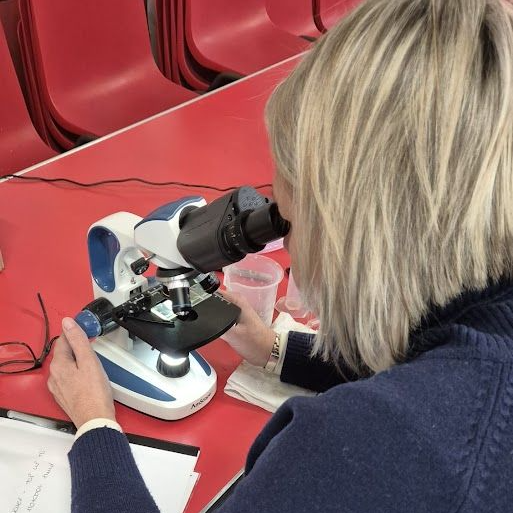
Faecal egg counting is not difficult and our workshops guide you through every step of the process – from collecting the dung to identifying the different parasites you will see under the microscope.
We use a technique called the modified McMaster method. This requires 3g of manure per sample, which is then mixed with a flotation solution, strained and piped into a calibrated slide for examination under the microscope. We provide comprehensive handouts that show in detail what you can expect to see and we are there throughout to help you with identification – no question is a silly question!
Once you have identified any worm eggs and/or coccidia, we can discuss whether your animal requires treatment and, if so, what products might be suitable.
“I recently attended Sarah’s wonderful FEC course and highly recommend it. It was so much easier than I’d expected and I wish I could have done it sooner.”
Rachel – Lincolnshire (June 2025)

There are few restrictions on what animals you can test using this method. Although most workshop attendees keep livestock, equines and camelids, domestic pets are also easy to test and we have even had samples from emus, wallabies, rabbits, meerkats and reindeer!